 Science:
Subject Information Overview
Below is a visual overview of the content available on this page. Click the appropriate title to view the relevant section
Curriculum
Area Staff Curriculum
InformationCurriculum
OverviewExam information for GCSE
qualifications in this Subject AreaKnowledge
Organisers
Curriculum Area Staff
|
Curriculum Director – Humera Carter |
Annalise Lumley Jenny Mackey (AAP) |
Should you require more information about this subject area please contact:
Name: Mrs H Carter
Position: Curriculum Area Leader
Email: huc@selbyhigh.co.uk
Curriculum Information
The Science curriculum is based upon the belief that a sound understanding of science is vital for all students to make sense of many different phenomena that we all experience in our day to day lives. The curriculum passionately conveys the idea that a sound grasp of scientific concepts and skills is fundamental in understanding the world around us, enabling us all to make considered choices and decisions in an ever changing world. Advancements in knowledge and understanding make extensive leaps and impact upon us all, often carrying moral and ethical dilemmas that we all should have an awareness of and be able to critically consider. Our aim is to ensure that every single student leaves Selby High School with the ability to unpick the scientific developments that they hear about in the news and to gain insight into how science impacts many facets of our daily lives from medicine, energy demands, farming, right through to the impact we have on the world around us and our capacity to continue to exist .
Through science lessons we aim to ensure that all children will gain a broad and balanced knowledge of all three strands of science (biology, chemistry and physics).
We will build a strong foundation of key ideas starting with energy, cells and atoms at KS3, building upon this into more complex concepts as students study their GCSE courses.
Students will cover all the content set out in the National Curriculum and the GCSE exam specification.
The key knowledge and concepts covered throughout their time at Selby High School are outlined below, and the carefully designed spiral curriculum, allows students to come back to these ideas in more and more depth as their learning journey continues.
Biology: Cells, Organ Systems in plant and animals, Infection and Immunity, Bioenergetic processes (respiration and photosynthesis), Homeostasis (hormones and the nervous system), Inheritance and Evolution, Ecology.
Chemistry: Atomic structure & the Periodic table, Chemical bonding and the properties of matter, Quantitative chemistry, Chemical reactions/changes, Energy changes , Rates of reaction, Organic chemistry, Chemical analysis, Chemistry of the atmosphere, Using resources.
Physics: Energy, Electricity, Particulate models, Nuclear physics and radiation, Forces, Waves, Magnets and Electromagnets, Space.
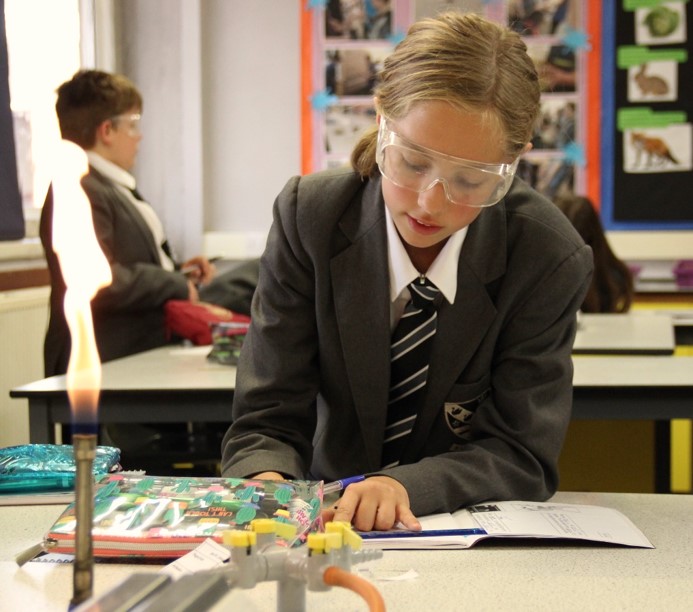
In addition to the knowledge they will acquire, students will also develop a wide range of practical skills, and the ability to assess risk, analyse data, evaluate evidence and draw conclusions.
We will deliver engaging lessons which allow all students to be stretched yet feel able to achieve. Students should feel supported and have the confidence to take risks and work independently in the pursuit of excellence.
To enhance the experience of students at Selby High School and expand their horizons, the science team offers a wide variety of courses, trips and activities which promote a lifelong love of learning.
Our aim is to ensure that every single student leaves Selby High School with a broad understanding of the key knowledge and concepts in Biology, Physics and Chemistry. We also want students to be able to critically assess the scientific developments that they hear about in the news and to gain insight into how science impacts the many facets of our daily lives from medicine, energy demands, farming, right through to the impact we have on the world around us and our capacity to continue to exist.
Curriculum Overview
Below is a summary overview of the topics and their content that will be studied in each term by each year group. For more information about each topic, get your child to visit learning journeys and resources on the school online learning platform - Ready Steady Learn.
| Year Group | Terms 1 & 2 | Terms 3 & 4 | Terms 5 & 6 |
| 7 |
Thinking in Science 1 7C1 Particles 7P1 Electricity Y7 Science project |
7B1 Cells 7C2 Element and compounds 7P2 Forces |
7C3 Acids and alkalis 7B2 Reproduction 7P3 Space |
| Assessment details |
Year 7 Assessment: - There will be 3 assessments spread throughout the year. They will focus on the content studied up to that point in the year. |
||
| 8 |
Thinking in Science 2 8C1 The Earth 8P1 Powerstations |
8B1 Anatomy 8C2 Chemical Reactions 8B2 Choices |
8P2 Waves 8B3 Ecology 8C3 Material Science Endangered Species project |
| Assessment details |
Year 8 Assessment: - There will be 3 assessments spread throughout the year. They will focus on the content studied up to that point in the year. |
||
| 9 |
9B1 Cells 9P1 Energy 9C1 Atomic Structure |
9C1 The Periodic table 9B2 Organisation 9C5 Energy Changes |
9P3 The Particle model 9C8 Chemical analysis Practical Skills development |
| Assessment details |
Year 9 Assessment: - There will be 3 assessments spread throughout the year. They will focus on the content studied up to that point in the year. |
||
| 10 |
B2 Organisation P2 Electricity C2 Bonding B4 Bioenergetics |
C6 Rates of reaction P1 Energy C5 Energy changes P4 Atomic structure |
C7 Organic chemistry B7 Ecology C8 Chemical analysis |
| Assessment details |
Year 10 Assessment: - There will be 3 assessments spread throughout the year. They will focus on the content studied up to that point in the year. |
||
| 11 |
B5 Homeostasis B6 Inheritance Mock preparation |
C3 Quantitative chemistry C4 Chemical changes Mock preparation |
P6 Waves P5 Forces Exam preparation |
| Assessment details |
Year 11 Assessment: - There will be 3 assessments spread throughout the year. They will focus on the content studied up to that point in the year. |
||
KNOWLEDGE ORGANISERS
A Knowledge Rich Curriculum at Selby High School
Research around memory suggests that if knowledge is studied once and not revisited or revised, it is not stored in the long-term memory. This means that after one lesson, or revising for one test, the knowledge will not be retained unless it is studied again. It won’t be recalled unless it is revisited frequently, which will embed it in the long term memory. In the long term this makes recall far easier. As part of home learning, students should be revising what they have been taught recently but also content they were taught previously. Therefore as part of our strategy to embed learning over time we have started to develop knowledge organisers across all year groups and curriculum areas. These will provide key content and knowledge allowing students to pre-learn and re-learn, a vital part of processing all the information required to be successful in the new style GCSE’s.
Instructions for using your knowledge organisers
KS3 = Years 7, 8 & 9
KS4 = Years 10 & 11
Below are the knowledge organisers for each topic in this subject. These knowledge organisers will become embedded in the Learning Journeys for each topic as they are created on Ready Steady Learn.
Exam information for GCSE qualifications in this subject area
Click each link below to view the full specification:
AQA GCSE Trilogy Combined Science